Investor sentiment towards PayPal reached new low last week as the stock dropped to a level not seen since 2017:
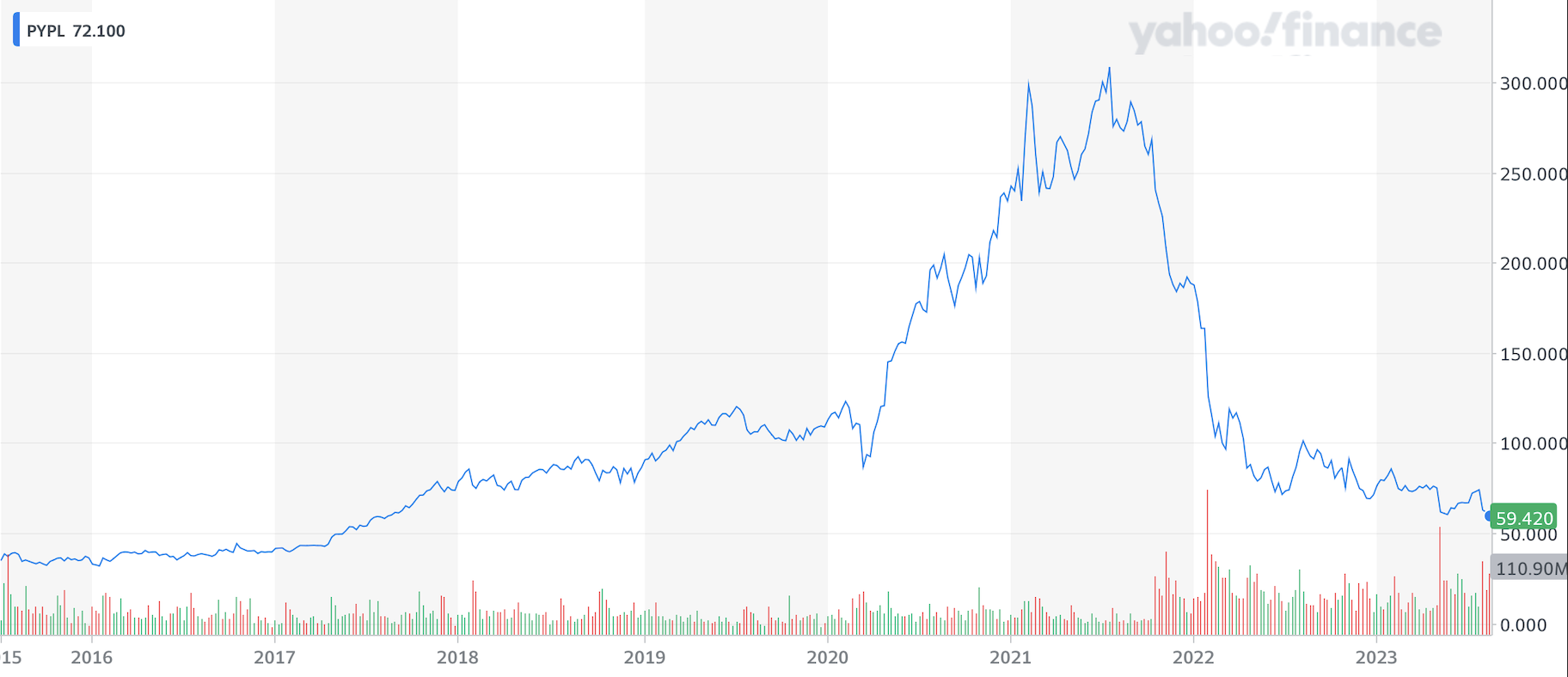
The pessimism stems from declining transaction margin, unstable leadership that has dented credibility after missteps post-Covid, fierce competition in the payment world and a shrinking active account base. The bears have reasons to question PayPal’s outlook, but I think that it’s a bit dramatic to call doom on PayPal and that the firm can turn it around. Here is why:
Change at the top
On Monday, PayPal concluded its search for the next CEO with the appointment of Alex Chriss from Intuit. First and foremost, the announcement ended the uncertainty over the firm’s leadership. Given the recent lack of investor confidence, this is much needed news. Second, Alex Chriss’ credentials show where the focus will be moving forward. Mr Chriss joined Intuit 19 years ago and rose through the ranks to lead Intuit Small Business segment. PayPal recently launched PayPal Commerce Payments Platfom (PPCP), which is targeting Small Businesses and intended to generate higher margin for the company than its unbranded processing business for big merchants. The company is hoping that Mr Chriss will replicate his prior success and elevate PPCP and the business in general to new heights.
There is no guarantee that the new CEO will perform his magic. He will need to find his own permanent CFO. But at least we now know who will take the baton from Schulman after September 2023.
Transaction margin
One of the biggest reasons why the stock fell to its low is that transaction margin declined for three consecutive quarters. Since most of PayPal’s revenue and profit is transaction-based, this is a key metric to gauge the company’s health. Even though the absolute margin numbers trend in the wrong direction, there are factors in place that can assuage investor concern:
- Branded checkout, the segment that usually generates high-margin, signed up more large merchants which came in at lower take rates than SMBs. Braintree is expanding to Europe where interchange rates are capped and, as a result, take rates are also lower than in the US. These new businesses impact transaction margin, but they also make the pie bigger. A short-term pain in exchange for a shot at long-term gains.
- PayPal sunsets some legacy businesses like invoices that have high margin. At least the company won’t be encumbered by high-maintenance old tech stacks any more.
- Year-over-year margin comparison (which negates seasonality effect) is also impacted by unfavorable foreign exchange hedges. PayPal’s decision to tighten credit criteria and increase loss provision regarding Business Loans plays a role as well. Once we go past these noises, we can see ta full and clean picture of transaction margin
The management team expected transaction margin to improve in the back half of 2023 and next year. We’ll see if this forecast will come true, but we can see why they think so.
Modernized infrastructure
Being a global payment company like PayPal is demanding on infrastructure. The system has to be online at all times and transactions need processing in about 1-2 seconds at most. Security is non-negotiable. Compliance in various jurisdictions must be followed. Customization is required to meet the business demands of big merchants. Innovation ought to be implemented regularly on both merchant and consumer sides to compete in a tightly-contesting market.
With that being said, it’s unthinkable to me that PayPal used to operate on old tech stacks that were high-maintenance and didn’t really talk to one another. Hence, it’s a good sign that the company went through a painful process to modernize its infratructure. Per the current CEO – Dan Schulman:
Venmo came with the Braintree acquisition, separate platform, separate processing, separate payment stack as PayPal had four legacy payment stacks. Some C++ libraries in there, a number of things, and Braintree had its own payment stack as well. So the goal, starting eight years ago, was to bring all of these together onto a single modern payment platform. And we have been — it’s like open heart surgery on us while we’re running a marathon because it’s our payment processing stack. It can’t go down for a second — it really can’t go down for a second. And if we don’t upgrade it though, you’ve got six payment stacks with massive legacy in there. You can’t scale efficiently. You’ve got a tremendous number of engineering talent just focused on fixing everything, your cyber defenses are lower. And so, we went about a massive planned upgrade. And one of the reasons I’m jumping on this right now is that literally a month ago, we finished completely. We fully deprecated every one of our old payment stacks, all of them, and we have PayPal, Venmo and Braintree all running on a modern payment stack behind everything together today. Therefore, we can start to do a ton of things that we could not do with that legacy infrastructure that we had in place before, including things like interoperability between Venmo PayPal as well.
I am working at a medium-sized financial institution that is much smaller and less sophisticated than PayPal. There are a lot of manual and inefficient processes we run internally to accommodate the inadequate infrastructure. Every initiative related to underlying technology demands plenty of deliberation, collaboration, time and commitment. The wheels don’t turn quickly. Hence, it’s an achievement for PayPal to rip the band-aid off and finally modernize its tech stacks. The new infrastructure will enable the company to run more efficiently and effectively in the future.
Venmo, Venmo, Venmo
Venmo has 60 million monthly active users (MAU), making up one-third of PayPal’s total MAUs despite being available only in the US. However, Venmo generates less than 10% of the company’s US revenue while having less than 10% of the active merchant base. As a result, there is a lot of headroom for PayPal to monetize the highly popular Venmo. The cherry on top is that revenue from Venmo has a higher margin than other businesses; which can improve the transaction margin.
Competition
Whether it’s payment gateway, unbranded & branded processing, BNPL or P2P, every segment where PayPal operates faces tough competition. Nonetheless, PayPal has competitive advantages that can enable the company to effectively compete:
- PayPal has the highest approval rate among processors. To merchants, this matters. Every additional approval means more money in the pocket. As long as PayPal can retain this capability, it has a chance to compete with other processors.
- More than 400 million active user accounts, 30 million active merchant accounts and 190 million monthly active user accounts. That’s a serious scale that is difficult to recreate for a competitor.
- Braintree is primarily in the US, where it is one of the premier processors for large merchants. If PayPal replicates similar success in international markets, revenue will receive a boost and there will be a lot more data that PayPal can use to improve fraud protection and increase approval rates.
- Its “Pay in 4” is the most popular among teens in the US and one of the best BNPL solutions on the market.
- Venmo trails only Cash App among P2P apps that US teenagers prefer.
PayPal is one company for which I have mixed feelings the most. While I have serious concerns over how the business was run in the last few years, as I laid out in “Concerns over PayPal’s New Plan – Unbranded Processing“, I continue to be bullish over a few elements of the business, like what I mentioned above. I, for one, look forward to the next four quarters and seeing what Chriss and his own management team have to offer.

 Minh Quang Duong
Leave a comment