Per Axios:
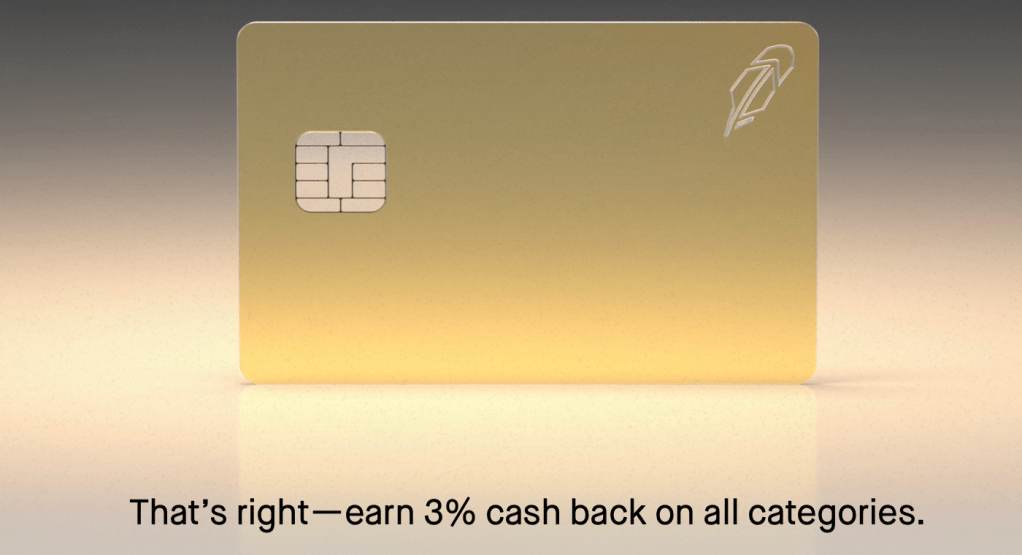
Robinhood unveiled its first-ever credit card, the Robinhood Gold Card, during a first-ever product keynote event in New York City Tuesday night.
There’s no annual fee for the card, but it will require a Robinhood Gold membership, which runs $5 per month, or $50 annually. Features, in addition to the 3% cash back, include no foreign transaction fees, a companion app that makes it relatively simple to create virtual and one-time cards, and the ability to set up cards for up to five family members with spending limits.
Robinhood Gold, meanwhile, gives investors additional benefits, such as 5% APY interest on uninvested cash and a 3% match on Robinhood Retirement IRA contributions.
Clearly, the new credit card is the first of its kind and likely going to be a loss center for Robinhood.
At 3% cash back, the card is almost guaranteed to lose money on every transaction. Even dining and travel usually have interchange rates around 2.2-2.8%. The loss is even worse on high-frequency categories such as gas and grocery which tend to have 1.1-1.8% in interchange rate. At major retailers like Walmart, Amazon or Costco (it’s a Visa), Robinhood will take the biggest hit because these are popular shopping places and they manage to negotiate with the networks to lower interchange to 0.7%. In other words, every transaction at such merchants, Robinhood will lose about 2.3% of the transaction volume.
Sure, the Robinhood Gold membership fee will act as a cushion, but at $5/month, it will only take cardholders around $2,000 to recoup their money. Not a high amount. On top of that, Robinhood is on the hook for 5% APY on uninvested cash. Yes, the uninvested balance is cash that Robinhood can invest and profit from, but will they clear the 5% hurdle every time? I am not sure. Oh, did I mention that they would give 1% back on uninvested balance, in addition to the 5% APY? And 3% IRA matching? Whatever plan they have but don’t share, unsurprisingly, must be really good to make the maths work.
Furthermore, Robinhood will enjoy a lot of earned media and word of mouth in the months to come. Because prospects can apply through an app, Robinhood will not have to invest in usual channels such as Direct Mail. I can tell you that not having Direct Mail will relieve the fintech firm of many operational expenses. Hence, their cost per account will be low.
But even if that is the case, the card itself will be an expensive loss leader.
What about losses? The young clientele that Robinhood has is riskier than wealthier, older and more mature folks on the market. If they are not careful, losses will run high and make the whole card book even less sustainable.
Theoretically, Robinhood can use their 1st-party trading data to deploy an underwriting model. The problem is that any model needs to have two things: 1/ training data or in other words, a decent account base and 2/ enough time for card accounts to mature so that they can access the effectiveness of such model. But at first, Robinhood will have to tolerate some risks and acquire accounts with a suboptimal model. Plus, why kill the word of mouth momentum by being picky?
I suspect that Robinhood will likely raise Gold membership fees very soon. Plus, they want to diversify the customer base by attracting more seasoned and richer investors.
Either way, I am excited to see how the card will do in the future and personally, if offered an opportunity, I’ll get the card for myself.
Note: I crossed out a sentence in my original post above. I shared this post on Hackernews and received feedback that the sentence was wrong. And it was. I want to be transparent about it and admit my mistake.
 Minh Quang Duong
Leave a comment