Per 9to5Mac:
Apple has upped the price of iCloud storage in the United Kingdom and some other geographic regions, possibly reflecting changes in foreign currency exchange rates. iCloud pricing in the United States remains the same.
For free, Apple gives each Apple ID a paltry 5 GB of cloud storage, an amount that hasn’t changed since iCloud was first introduced all the way back in 2011. Paid iCloud+ plans are currently available in three tiers: 50 GB, 200 GB, and 2 TB.
The monthly price of iCloud storage has increased by about 25% for UK Apple customers. Similar rises have also been applied to a handful of other markets around the world
I feel like this is a harbinger for what Apple will do in the next few months. A test on select market to see customer reaction before the same raise is applied to all markets, including the all important domestic playground.
iCloud is the one Apple service that Apple users won’t be able to live without. Backup, extra storage in addition to insultingly 5GB each phone has, Private Relay, Hide My Email, Passwords and Keychain and so on. To me personally, it’s important to be able to save some of my library on the cloud instead of having to routinely clear out photos and videos to save storage. Apple wants to take advantage of this reliance on iCloud to squeeze more money. If this test which involves a big market in the UK and smaller ones is successful, expect to see the same move wherever you live.
The “make a service more valuable and raise price over time” playbook is not new. But what I really want to talk about is Apple One and how it’s priced. Apple One is the flagship bundle that includes other services such as as iCloud, Apple Music, Apple TV+, Apple Fitness+, Apple Arcade and Apple News+. Before we continue, let’s look at the individual components.
iCloud is undoubtedly THE most important among the bunch and, I think, has the highest margin. Although Apple may have to pay third-party providers for Private Relay or Hide My Email, the service mostly incurs very little costs every time an extra GB is used. As I mentioned above, iCloud is indispensable and sticky among Apple users.
Apple TV+ is Apple’s version of Netflix, except that it has primarily bespoke high quality IP, and barely any third-party content. Even after Apple raised the service’s price by 40% for the first time back in November 2019, TV+ is still competitive compared to the likes of Netflix, HBO or Disney+. As the company enriches the content library over time, don’t be surprised that another price hike may come sooner than you expect. Moreover, TV+’s marginal cost depends on agreements between Apple and artists, and varies from one material to another. Specifically, the company may pay upfront everything and won’t have to reimburse artists again in the future. In this case, any additional revenue TV+ can bring in has zero marginal cost. On the other hand, if Apple agrees to pay artists based on the financial success of a piece of content, then every extra revenue dollar has marginal cost.
Apple Music is the direct competitor of Spotify. In terms of marginal cost, Apple has to pay a small fee every time a song is streamed. Given that the service is already more expensive than its biggest rival, unless Apple has a plan to add more value, I don’t see a price hike for Apple Music.
Apple Fitness+ houses first-party wellness and fitness workouts that Apple produces in-house at the Apple Fitness Studio with a team of coaches. I strongly suspect that because Apple employs these coaches, the company owns the content completely and won’t have any marginal cost whenever a new Fitness+ subscriber comes in.
Apple News+ is a news subscription that lets users access paywalled magazines and articles from participating outlets. Because these partner media companies need to make money on their content, Apple has to share News+ revenue with them based on usage.
Apple Arcade is another subscription, but for gamers. Apple works with developers of all size to produce games and gives users access in exchange a fee. I do think that Apple has a revenue-sharing agreement with developers. Hence, this is another service where Apple has marginal cost. Because the company consistently adds more games to the library, depending on how popular it is (which Apple has barely disclosed), Arcade may get more expensive in the future.
Not every service is equally popular. I feel like iCloud is a level above the others while TV+, Music and Fitness+ are more desired than News+ and Arcade. Instead of investing to push each and every service, Apple leverages this bundle and the more popular services to lift up the others. Plus, customers are less likely to leave the ecosystem when they are subscribed to multiple services or, by proxy, Apple One. Below is how the bundle is currently constructed:
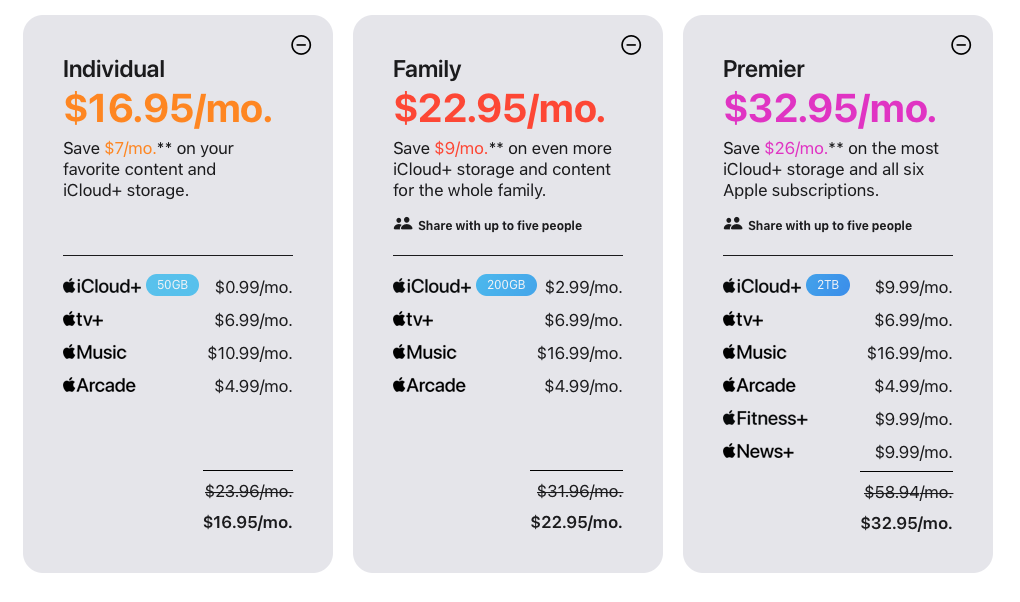
The idea is that Apple One presents savings to subscribers compared to when they have to pay for services individually. As a consequence, any price hike on individual services, provided that Apple One stays the same, will make the flagship subscription more appealing. Let’s run a couple of scenarios.
In scenario A, we look at the current Apple One plan. In scenario B, we keep intact the prices of News+, Arcade and Apple Music while raising the prices of iCloud, TV+ and Fitness+. In scenario C, we start from Scenario B and add $0.5 on iCloud and $1 on TV+. I chose these services to raise prices on because they likely have lower marginal costs than others, helping Apple with gross margin profile. This is what the scenarios look like:
| A – Current Plans Per Month | B – Scenario A + $1 on the first 3 services | C – Scenario B + $0.5 on iCloud and $1 on TV+ | |
| iCloud (2TB) | $9.99 | $10.99 | $11.49 |
| TV+ | $6.99 | $7.99 | $8.99 |
| Fitness+ | $9.99 | $10.99 | $10.99 |
| Music | $16.99 | $16.99 | $16.99 |
| News+ | $9.99 | $9.99 | $9.99 |
| Arcade | $4.99 | $4.99 | $4.99 |
| Sum | $58.94 | $61.94 | $63.44 |
| Blue + Green | $43.96 | $46.96 | $48.46 |
| Apple One Premier | $32.95 | $32.95 | $32.95 |
In scenario C, Apple One Premier presents a 33% discount on the value of services in Blue and Green and a 50% discount on all services. As you can see, even small price adjustments can elevate the appeal of Apple One Premier. There are quite a few things that Apple can play around with its services and bundling. For instance, a new tier of Apple Music that includes both Apple Music and Apple Musical Classic, the latter of which costs $14.99. Or the company can create another Apple One tier that includes Apple Care+ or the upcoming Emergency SOS feature fee.
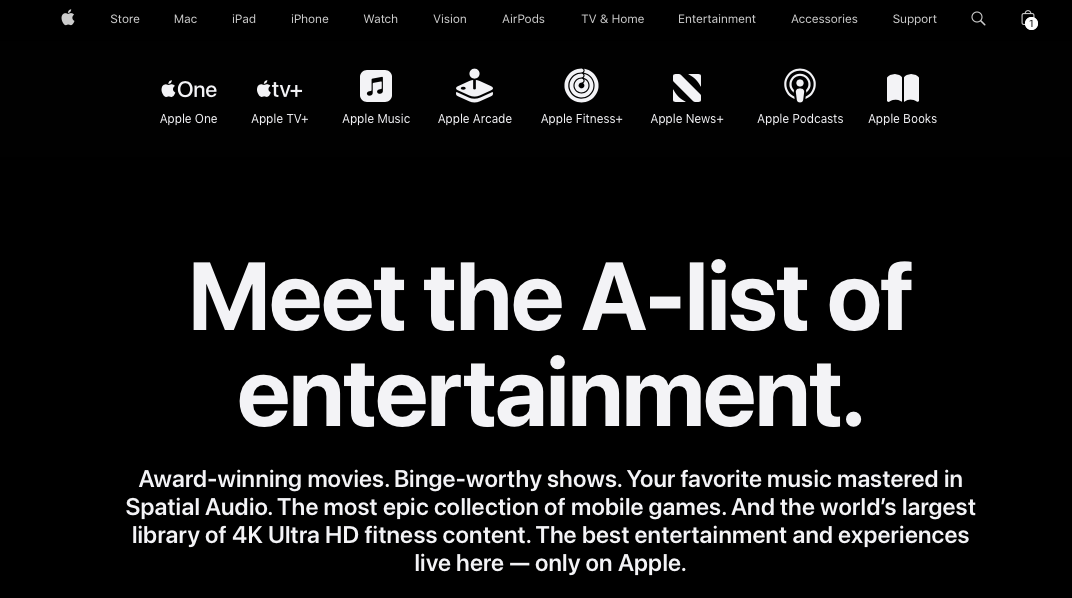
In short, Apple has a few levers at its disposal to stimulate growth in the future. I wrote about Apple Business Essentials before and I believe that the company has a long-term plan to go into the SMB space. New products like Apple Watch Ultra or Vision Pro can help acquire niche customers. Advertising brings high-margin dollars and has already been mentioned as the catalyst for Services growth in several quarters. Apple Pay is well-liked, generates revenue on every transaction, yet has numerous countries to expand to. And of course, optimizing subscriptions and Apple One, as I laid out above, is another avenue. To know how serious Apple takes these services, they now occupy a page on its platform under Entertainment.
Disclaimer: I own Apple stocks in my personal portfolio.

 Minh Quang Duong
Leave a comment