This quarter marks a significant milestone for Uber as the company unlocked two achievements for the first time: 1/ a quarterly free cash flow of $1 billion and 2/ GAAP operating profit.
| Metric | Q2 2022 Results | YoY Change | Note |
| Monthly Active Platform Consumers | 137 | 12% | Almost twice as many as the company had 5 years ago |
| Trips | 2,282 | 22% | On average, an active consumer takes 5.6 trips per quarter. It almost doubled in the last 5 years |
| Gross Bookings | $33,601 | 16% | Average trip size is $14.16, the highest since Q2 2021. Bookings is almost 3x as big as it was in Q2 2018 |
| Revenue | $9,230 | 14% | The highest quarterly revenue ever. Last-12-month revenue exceeded $35 billion |
| Operating Income | $326 | First time ever on a GAAP basis. GAAP basis includes charges such as Stock-based compensation, which is controversially excluded by a lot of tech companies | |
| Free Cash Flow | $1,140 | 198% |
I said before in “Updates on Uber“, the company is a long-term beneficiary of the pandemic.
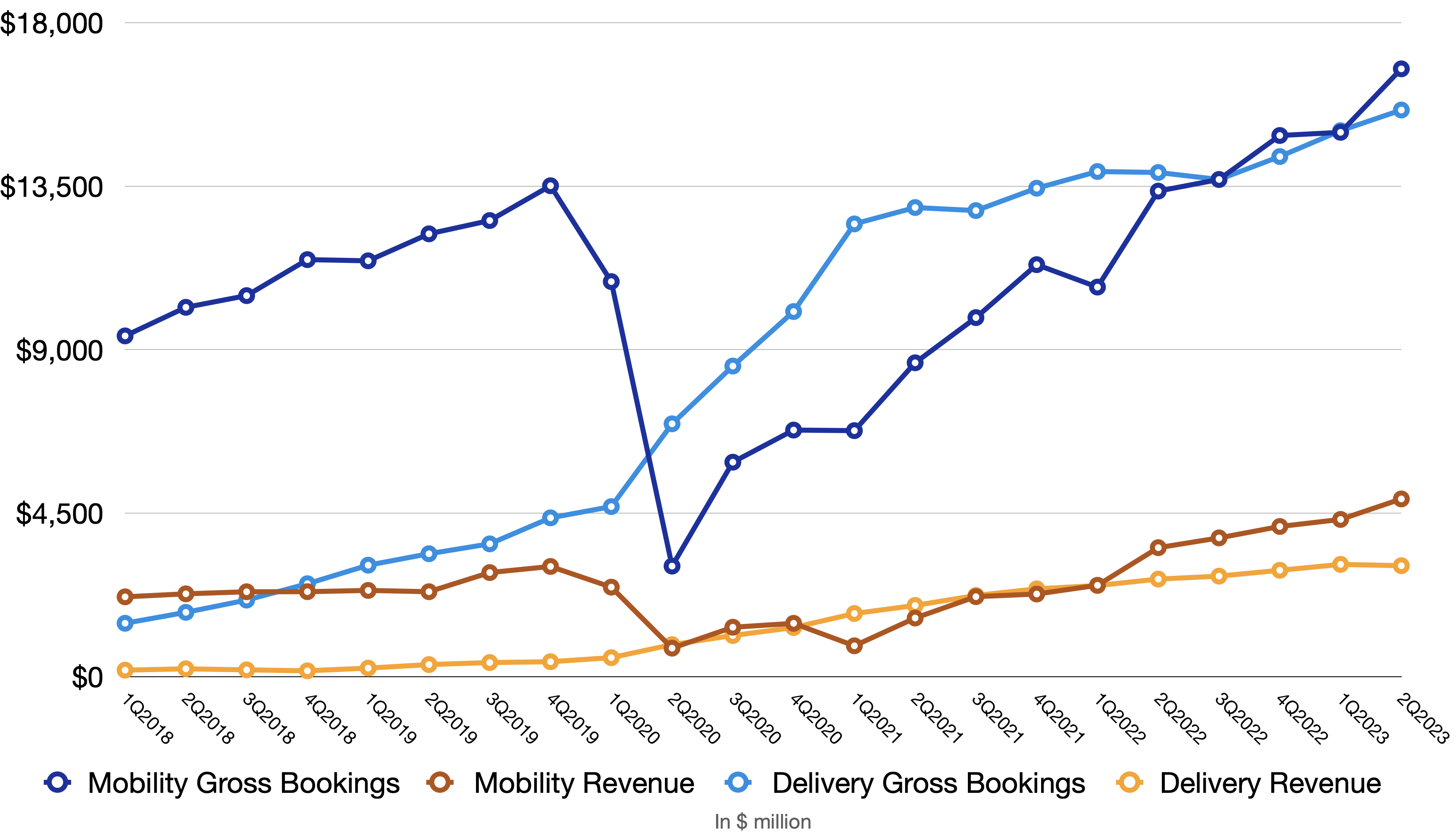
This chart illustrates how the two biggest segments of Uber have evolved in the last few years. At first, Mobility was the dominant force while Delivery was still growing at a smaller scale. Then, the pandemic came. Stay-at-home order and the risk of infection decimated Mobility but turbocharged the growth of Delivery. Three years later, Mobility is once again the biggest contributor, but Uber now has two businesses of equals. Without Covid, I don’t know if we would have had the Uber of today.
In the beginning, Uber had to spend a lot of money on acquiring drivers, merchants and drivers. Discounts for consumers, bonuses for drivers and monetary support for merchants, you name it. I remember when the service was still available in Vietnam, we got discounts all the time and drivers told me the bonuses were generous. To be profitable, the company has to find a way to retain all participating parties and activity without subsidies. The fact that Uber is now profitable on a GAAP basis means it managed to do just that and reached the long elusive destination.
This milestone has two consequences. First, it’s irrefutable proof of how effective and competent Dara and his team have been. Running a three-sided market on a global scale is no joke. The pandemic, the fierce competition, regulatory scrutiny and the pressure to deliver both profitability and growth make the task inconceivably challenging. So kudos to the management.
Secondly, every Uber competitor is now under more pressure to be in the black while maintaining growth. Take Lyft as an example. The firm cut costs and spent capital to drive prices down without hurting drivers. The move makes sense, but how long would it last? How much time does Lyft have before investors turn around and demand to see actual profits? The bad news for rivals is that Uber’s business seems to be firing all cylinders:
- The number of active merchants reached 1 million, double in the last three years
- The number of mobility active drivers rose by 33% YoY and driver engagement grew by 7%
- In US and Canada, the biggest market, the number active merchants increased by 9%
- Uber One members made up 27% of total gross bookings
- High-margin advertising revenue reached $650 million on an annualized basis
Stickier consumers are more active on the platform, attracting drivers and merchants. A bigger merchant base expands optionality for consumers and lures drivers to the mix. Meanwhile, more drivers mean shorter waiting time and better user experience, something that the other two parties are about. The flywheel is turning stronger than ever. Look around, you’ll be pressed to find a competitor that can really compete with Uber.
Are there causes for concern? Of course. The CFO is stepping down in January 2024. Uber didn’t have a CFO until Nelson Chai was appointed after Dara became CEO. His tenure has seen Uber disciplined in expenses and duly delivered on promises made to investors. Whoever his successor is will have to continue to deliver such discipline and profitability. Furthermore, there are always regulatory risks lurking in the background. An unfriendly bill can inflict unwanted expenses on the business.
Overall, a historic quarter for Uber. A resounding validation of their efforts. Yes, they lost a lot of money in the previous decade to get here, but as they always say, better late than never.

 Minh Quang Duong
Leave a reply to Weekly reading 5th August 2023 – Minh Quang Duong Cancel reply